
Friday, June 17, 2011

BPA in Receipt Paper: Cause for Worry….Or Not?

Over the last year I have read numerous articles about BPA and its possible toxic connections to cancer, learning disabilities and infertility. POS Supply Solutions has been following the news on BPA’s effects on human health since 2006 and we have even written two other posts on BPA in Thermal Paper and Identifying BPA Free Paper in the last year. With all the blog posts, independent studies and government reports to sift through, it’s hard not to get confused and overwhelmed by all the information. Here’s the latest news that I have read regarding BPA recently:


Last month on the 23rd, the Environmental Health Research Foundation (a nonprofit research foundation specializing in Health and Environmental Science) stated “Despite the prevalence of recent media articles and blogs about Bisphenol A (BPA), there has been no change in US regulatory policy”, “The Food and Drug Administration (FDA) position on BPA remains unchanged, noting the lack of any creditable evidence of risk to human health”. In addition, the US Environmental Protection Agency’s (EPA) has stated that further regulation on BPA would require more scientific findings than are currently available.

On June 8th, the state of Connecticut House of Representatives approved a bill banning BPA in store receipts after a lengthy debate. This bill would take effect beginning July 1, 2015 unless the EPA issues a mandate before then. The state decided to delay the ban until the middle of 2015 to prevent a burden on businesses that may already be under excessive regulations, giving them time to develop alternatives. Maybe they don’t realize that business owners already have alternatives today? We at POS Supply Solutions have been offering BPA free receipt paper rolls for over 5 years.

What are your feelings are on the subject? Do you think that BPA should be banned in all receipt paper? We’d love to hear your take on this controversial topic!

Tuesday, June 14, 2011

Less is Not Always More: 3 Reasons Larger Point of Sale Paper Rolls Save Time and Money


In an effort to save money, a large number of customers are now ordering smaller point of sale paper rolls. While it may appear to be a cost savings to order a smaller roll, the cost per foot is actually higher than larger rolls. Most standalone POS thermal printers can hold a 3 1/8” x 301’ paper roll, however we are seeing an increase in sales of 200', 220’, or even smaller rolls. Credit card terminals normally hold a 2 ¼” x 110’ paper roll but people are often buying the 80’, 85’ or even smaller. Simply put, ordering the largest roll your terminal or printer can handle is the wisest choice. Here's why:

  1. Larger Rolls reduce your shipping, handling and warehousing costs. Purchasing larger paper rolls means a reduction in your shipping and handling because you have to order less often. 
  2. Less roll changes and register downtime save valuable time and money. Changing rolls less frequently equates to lower personnel costs and an increase in customer satisfaction. The time you save can be better spent servicing customers! 
  3. Larger rolls offer a lower cost per foot of paper. While there is a higher up front cost, the larger paper roll is actually less expensive and lasts longer.
Smaller Rolls Just Don't Measure Up
Check out our roll comparison sheet below to see the yield differences:


If you purchase a 2 1/4" X 110' Roll:

Original Roll Size
Increased Yield  
with 110' Roll
2 1/4" X 80'
38%
2 1/4" X 85'
29%

If you purchase a 3 1/8" X 301' Roll:


Original Roll Size

Increased Yield 
with 301' Roll 
3 1/8" X 200'
51%
3 1/8" X 220'
37%
3 1/8" X 230'
31%
3 1/8" X 273'
10%


Our paper roll products are designed to deliver high performance and compatibility in all common transaction printers while minimizing the user's total cost of ownership. Our paper rolls are used in a wide range of applications including Point-of-Sale, Cash Register, Credit Card Terminal, Kiosk, Fax, Pay-at-the-Pump, Medical, Casino/Gaming, Self-Check-out, Mobile Printers and many others.  

Thursday, April 21, 2011

Mobile Printers are Everywhere

The use of mobile printers has been steadily growing over the last few years. While these devices were originally designed mainly for small label applications, they are now being integrated into a wide variety of markets including public safety for accident reports and citations and hospitality for remote ordering and cashing out. Other industries include healthcare, retail, field services and manufacturing.

Flexibility and quick response time are a vital part of day-to-day business operations. The evolution of the mobile printer enables businesses to print on demand, instead of where they can access a desktop printer. Mobile printers offer great efficiencies such as real-time inventory control, customer communications and even invoices. They enable the user to print out high quality documents with crisp graphics and sharp text, wherever they are. The more popular mobile printers on the market include Zebra, O’Neil, Printek, Epson, Star, Seiko, Intermec, Radix, Casio, Brother/Pentax, Citizen and Extech to name a few.

Businesses can now print receipts, tickets, tags and barcode labels with relative ease. Paper options include bond or an array of thermal papers to fit a specific applications and environmental condition. We carry stock blank or custom printed mobile printer paper to increase company awareness and build brand loyalty.

If your company is looking for ways to increase productivity, accuracy and customer response time, mobile printers may be the solution for you. To find out more about our mobile paper offerings, please visit http://www.possupply.com/Mobile-Printer-Paper-Rolls.

Thursday, February 17, 2011

Identifying BPA Free Thermal Receipt Paper Just Got a Little Easier


How do you know if the receipt paper you are handling is BPA-Free or not? Up until recently, it has been virtually impossible because all BPA-Free thermal receipt paper looked exactly the same as non-BPA-Free. As we discussed in our December post, a study conducted by the Environmental Working Group in July of 2010 indicated that 40% of the receipts sampled from major retailers contained BPA. While the health effects are still unclear, this study has aroused concerns among consumers as well as retailers. We are pleased to announce that the market is changing.

In November Appleton, North America’s largest producer of direct thermal media announced the addition of easy-to-see red fibers to its most common POS receipt paper grade “Alpha 400-2.1”. Appleton designed its 'red fiber' BPA-free paper to help consumers and retail workers quickly identify the kind of thermal receipt paper they are handling. It is important to note that all Appleton thermal paper is BPA-free, but only the most common receipt grade contains the red fibers.

At this time, offshore supplier Koehler also has BPA-free receipt paper; their grade "KT48FA". Koehler is a large supplier of thermal paper to the US. This simply means that your thermal receipt paper may be BPA-Free even if it doesn't have red fibers.

If you purchase thermal receipt paper and are concerned about the effects of BPA, ask your supplier about the BPA-free options available to you. You can visit http://www.possupply.com/BPA-Free-Thermal-Paper-Rolls for a complete list of the products that we offer.


Wednesday, January 5, 2011

How to Select the Best Thermal Paper for Your Application

Selecting the right thermal paper for your printing application is very important. Most documents look fine when they come out of the printer, but the true test is how they will hold up over their expected life span. When printed data is unreadable, problems with returns, service, warranties and compliance can arise.

The following key considerations should be examined before choosing a paper: Potential exposure to extreme heat or moisture, durability requirements, and intended lifespan. Examining the following areas will ensure documents remain intact and readable during their useful life.

Heat
If exposure to extreme heat is a concern, choose a material that is heat resistant. Documents left in vehicles, for example, where temperatures can climb over 150° F (66° C) in the summer can turn black and unreadable due to the chemicals in the paper reacting. To avoid this problem, some thermal materials are specially formulated to withstand higher temperatures.

Moisture
If your document will be subjected to moisture, either because it will be exposed to the elements or stored in a wet or humid area, a paper with additional moisture resistance or a synthetic material will protect the document from degrading and becoming unreadable.

Thickness (Durability)
Thicker materials tend to be more durable and are perceived by customers as higher quality. However, the thicker the material, the less paper per roll, resulting in fewer documents that can be printed before the roll needs to be changed.

Archivability (Intended Lifespan)
The longer documents need to be referenced and stored, the more durable they need to be, and the more protection they require from heat, moisture and other environmental factors. Storage is an important and often overlooked factor in a document's lifespan. Make sure the material you choose is rated to meet your archival requirements.

Topcoating
All thermal papers have a basecoat and a thermal coat, but not all have a topcoat. A topcoat provides an extra layer of protection against specific environmental exposure. Non-topcoated materials are acceptable for applications requiring limited resistance properties.

In our next post we will provide a detailed comparison chart of the papers we offer to help you choose the best thermal paper for your unique application. In the meantime, please contact us if you have further questions about thermal paper. Whether your application calls for heat or moisture resistance, archivability, extra durability, topcoating or a standard POS grade, POS Supply Solutions has the thermal paper roll solution for you.

Tuesday, December 7, 2010

BPA in Thermal Paper

The purpose of this document is to provide our customers and employees with information on Bisphenol A (BPA).

Does the paper that POS Supply Solutions purchases for use in thermal paper receipt rolls contain BPA?BPA Free Thermal Paper Roll

Some of the papers that are outsourced by POS Supply Solutions to fulfill customer requirements and used for retail receipts, gas pump receipts, ATM applications, and other point of sale transaction receipts may contain BPA depending on the source of the paper stock.

What is POS Supply Solution’s position regarding the safety of Bisphenol A?
POS Supply Solutions realizes that the use of BPA in thermal papers is a concern to our customers and the end users of thermal papers. POS Supply Solutions makes no claims regarding the safety of BPA as that is the job of agencies responsible for public health and safety. POS Supply Solutions has three action plans to address the concerns regarding BPA. The first is to monitor the ongoing studies and scientific debate on BPA. The second is to work with vendors from whom we purchase thermal grades containing BPA to assist them in finding alternatives to BPA if the scientific or legislative community recommends or requires such changes. The third is to respond to our customer’s requests for BPA free product.

Does POS Supply Solutions offer BPA FREE Thermal Paper?
POS Supply Solutions realizes that the use of BPA in thermal papers is a concern to our customers and the end users of thermal papers. POS Supply Solutions has a complete line of BPA FREE Thermal Paper Rolls. Please visit
http://www.possupply.com/BPA-Free-Thermal-Paper-Rolls for a complete list.

What is the best source of information on BPA health concerns?
The National Institute of Health (NIH) and the National Toxicology Program (NTP) have been working diligently to determine if BPA presents health and safety risks. NIH and NTP are agencies of the United States Government Department of Health and Human Services. They are affiliated with the Food and Drug Administration (FDA), National Institute for Occupational Safety and Health (NIOSH), Environmental Protection Agency (EPA), Occupational Safety and Health Administration (OSHA) and other agencies that assess risks to public health and safety. NIH and NTP are an excellent source of unbiased information based on scientific analysis of BPA. They operate some of the most respected research centers in the world. BPA toxicology has been a priority at NIH and NTP for several years. Their scientists are assessing its safety by reviewing and analyzing scientific data gathered from laboratories all over the world. We have provided a link to the NIEHS website below where you will find facts on BPA to better understand the issues surrounding BPA. Please spend some time on the website. You will find accurate information on BPA without the possibly inaccurate and/or biased information that can be found on the Internet and in the press.

What is being done to eliminate BPA from thermal paper?
The Environmental Protection Agency (EPA) has been working on this matter and is sponsoring an initiative designed to assist the thermal paper industry in finding safer alternatives to BPA as quickly as possible. Representatives from the thermal paper industry, large retailers (who use thermal paper), the scientific community, the chemical industry, the press, and other interested parties met in Washington with the EPA, NIH, NIOSH, NTP, and other federal health and safety agencies to launch the initiative. POS Supply Solutions will be working on the EPA steering committee and the working group focusing on finding and transitioning to alternatives to BPA.

Do all thermal papers contain BPA?
No, BPA is a component primarily utilized in some thermal point of sale receipt papers. Examples include gas pump receipts, cash register and ATM receipts. Recent independent analyses of thermal receipt papers used by large retailers indicate that roughly half of the receipts tested contained BPA. BPA is not commonly found in thermal labels, tickets and tags. Examples include supermarket labels, event tickets, airline baggage tags, etc.

Where can I find more information regarding the health and safety of BPA?
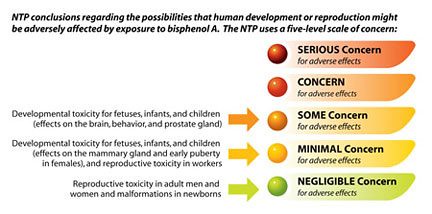
Please review the information below prepared by the NTP. It summarizes the results of NTP’s study on the possible effects of BPA and provides an excellent source of unbiased information.

BPA Concerns
MORE INFORMATION:

Tuesday, February 23, 2010

Thermal Paper Caliper & Basis Weight

This is our last post on the four main aspects of thermal paper that affect its grade.

Caliper: Paper Thickness is often referred to as caliper and is measured in mils or thousandths of an inch. Not matter if you are making books or rolls of paper the caliper and number of sheets or length in feet will determine the thickness of the book or the Outside Diameter of the roll. You may find the need to measure the caliper of the paper you are using to compare it to another product or to a printer specification at some point and it would be good to do that in an accurate number.

The best way to measure would be with a Micrometer which comes in a few styles. The best way to measure paper would be to fold the paper in half, fold it in half again, measure the thickness with your gage and divide by 4. This will give you an average over a few location points and you will not capture a high or low spot.

Basis weight: At times the basis weight of the paper will go hand-in-hand with paper caliper and the basis weight identifies the paper's weight in pounds of a ream (500 sheets) in the basic size for that grade. In metric terms would be the weight in one square meter of paper or f/m2. Basis 70 would mean that 500 sheets 25" x 38" would weight 70 pounds. This is equivalent to 104 g/m2 in the metric system.

Please Note: The basic size is not the same for all paper grades (25" x 38" for coated and offset, 17" x 22" for writing papers, 20" x 26" for cover papers and there are others). Typically if you're working with similar paper your basis size will be the same.

In summary, Sensitivity, Environmental Resistance, Archivability and Caliper are the four main aspects of thermal paper that affect its grade.